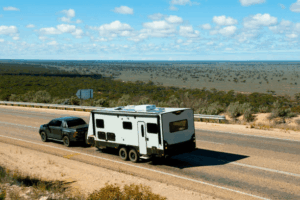
Austin is one of the best cities in the United States for RV travelers who need reliable internet. The combination of Texas’s largest tech ecosystem, extensive 5G infrastructure investment, and a thriving outdoor culture has made Austin-area campgrounds some of the best-connected RV destinations in the country. Whether you are working remotely from an RV park near Lake Travis, streaming from a site at McKinney Falls State Park, or using Austin as a base for Hill Country exploration, reliable cellular internet is consistently available throughout the metro area and its surrounding campground destinations.
RingPlanet’s nationwide 5G and LTE network delivers consistent connectivity across Austin’s RV destinations — from urban RV parks inside the city to rural campgrounds along the Highland Lakes chain west of Austin. For a complete guide to RV internet technology options, equipment, and data plans, see our Wireless Internet for RV complete guide.
Austin’s Cellular Coverage Landscape for RV Travelers
Austin’s status as a major technology hub has driven significant carrier infrastructure investment — making it one of the most comprehensively covered 5G markets in Texas. All major carriers have deployed mid-band 5G across the Austin metro area, with coverage extending through the suburban growth corridors to the north, south, and west of the city center.
For RV travelers, the practical implications are significant:
- Urban RV parks inside Austin: Strong 5G coverage from multiple carriers — download speeds of 100–300 Mbps are typical in well-covered locations
- Suburban campgrounds (Cedar Park, Round Rock, Pflugerville): 5G coverage on most carriers with LTE fallback — consistent performance for remote work and streaming
- Hill Country campgrounds (Marble Falls, Burnet, Llano): 4G LTE covers most established campgrounds — 5G coverage expanding along major corridors
- Highland Lakes (Lake Travis, Lake Marble Falls, Inks Lake): LTE coverage at most developed campgrounds — signal varies in more remote shoreline locations
Top RV Destinations Near Austin and Their Coverage
Austin East KOA
Located east of the Austin city center, this full-service RV park sits in strong LTE and 5G coverage territory. Urban proximity means multiple carriers deliver competitive signal strength — expect download speeds of 50–150 Mbps for remote work and 4K streaming without issues.
Pace Bend Park (Lake Travis)
Pace Bend is a Travis County park on a peninsula extending into Lake Travis — one of Austin’s most popular outdoor destinations. Coverage at Pace Bend varies by campsite location — sites on the eastern side of the park closer to the main road receive stronger LTE signal than sites on the western point. Bring an external antenna for the best performance at this location.
McKinney Falls State Park
McKinney Falls sits within Austin’s city limits and benefits from strong urban cellular coverage. This is one of the most connected state park campgrounds in Texas — multiple carriers deliver LTE and 5G service throughout the campground. Remote workers regularly use McKinney Falls as a base camp for Austin-area work stays.
Inks Lake State Park
Inks Lake State Park is approximately 70 miles west of Austin in the Hill Country — beautiful but in a cellular coverage gap for most carriers. LTE signal is available but variable — this is a location where an external antenna and signal booster make a significant difference to usable performance. Satellite backup is recommended for extended work stays at Inks Lake.
Bastrop State Park
Located 30 miles east of Austin, Bastrop State Park sits in reasonable LTE coverage territory. Signal strength varies by campsite — sites near the park entrance receive better signal than sites deeper in the lost pines forest where tree cover attenuates signal. Test signal on arrival and position the cellular router near a window facing the park entrance direction for best results.
Best RV Internet Setup for Austin
For Austin-area RV travel, the recommended internet setup is:
Primary: RingPlanet LTE/5G cellular router — covers urban parks and most suburban campgrounds at full streaming and work-capable speeds
Enhancement: External omnidirectional antenna for Hill Country and lakeside campgrounds where signal is adequate but not strong
Backup for remote locations: Satellite backup for Inks Lake, Pedernales Falls, and other Hill Country destinations where cellular signal is marginal
The cellular router from RingPlanet handles the majority of Austin-area campgrounds without any additional equipment — the antenna enhancement becomes valuable for the 20–30% of locations where LTE signal is present but not strong.
Remote Work in Austin-Area RV Parks
Austin’s tech culture has created a large population of remote workers who use RV parks as flexible office locations. Several Austin-area RV parks have specifically upgraded their facilities to accommodate remote workers — offering covered workspaces, reliable power connections, and marketing explicitly to digital nomads.
For remote workers, the cellular internet requirements in Austin are straightforward — 5G and strong LTE are available at virtually all urban and inner-suburban RV parks. The key considerations are:
Upload performance: Video calls require at minimum 10 Mbps upload. Austin’s 5G network delivers 20–80 Mbps upload in well-covered locations — more than adequate for any professional use case.
Latency: Austin’s 5G latency of 10–20ms is comparable to fixed office broadband — suitable for real-time collaboration tools, VoIP, and cloud application access.
Data plan adequacy: A full remote work day in Austin consumes 5–15GB of data. A month of full-time remote work requires 100–300GB of priority data. RingPlanet’s plans include adequate priority data allocation for full-time remote workers.
Navigating Austin Traffic for RV Parking
Austin’s rapid growth has created significant traffic congestion — particularly on I-35, MoPac (Loop 1), and US-183. For RV travelers planning to move between campgrounds or explore the city, morning and evening rush hours on these corridors should be avoided. Many long-term RV residents in Austin choose a single campground base and use a personal vehicle or rideshare for city exploration rather than moving the RV frequently.
The I-35 corridor through Austin also passes through areas of particularly strong 5G coverage — making transit connections reliable for mobile workers who need to check messages or make brief calls during repositioning drives.
What the FCC’s Coverage Maps Show for Austin
The FCC’s broadband coverage map shows extensive 5G and LTE coverage across the Austin metro area and into the surrounding Hill Country. The map identifies coverage gaps in the Pedernales River watershed, parts of the Llano Uplift, and some sections of the Colorado River canyon country west of Austin — useful for pre-trip route planning to identify where satellite backup becomes necessary.
Frequently Asked Questions
What is the best internet option for RV camping near Austin?
A no-contract LTE/5G cellular plan from RingPlanet covers the vast majority of Austin-area campgrounds at speeds suitable for remote work and streaming. For Hill Country and lakeside destinations with marginal signal, an external antenna improves performance significantly. For truly remote Hill Country locations, satellite backup provides the fallback coverage that cellular cannot reach.
Does 5G work at Austin RV parks?
Yes — 5G is available at urban and suburban Austin RV parks from multiple carriers. Parks within the Austin city limits and within 20 miles of the city center benefit from strong 5G coverage. Hill Country campgrounds beyond 40–50 miles from Austin rely on 4G LTE, which delivers adequate performance for most RV internet use cases.
Is there good cell signal at Lake Travis campgrounds?
Signal at Lake Travis campgrounds varies significantly by location. Eastern shoreline parks closer to Austin receive stronger signal than western shoreline locations. An external antenna improves performance at lakeside sites where the surrounding terrain attenuates signal. Sites at Pace Bend Park specifically benefit from antenna positioning — test signal on arrival to identify the best campsite.
How much data does a remote worker use per month at an Austin RV park?
A full-time remote worker making regular video calls, uploading files, and using cloud applications typically uses 100–300GB per month. Add streaming entertainment in the evenings and the figure rises to 200–400GB. A plan with at least 100GB of priority data is the correct starting point for Austin-based remote work RV travel.
Can I work remotely from McKinney Falls State Park?
Yes — McKinney Falls is one of the best-connected state park campgrounds in Texas. Urban cellular coverage extends throughout the park, delivering LTE and 5G speeds adequate for professional remote work including video calls and file uploads.